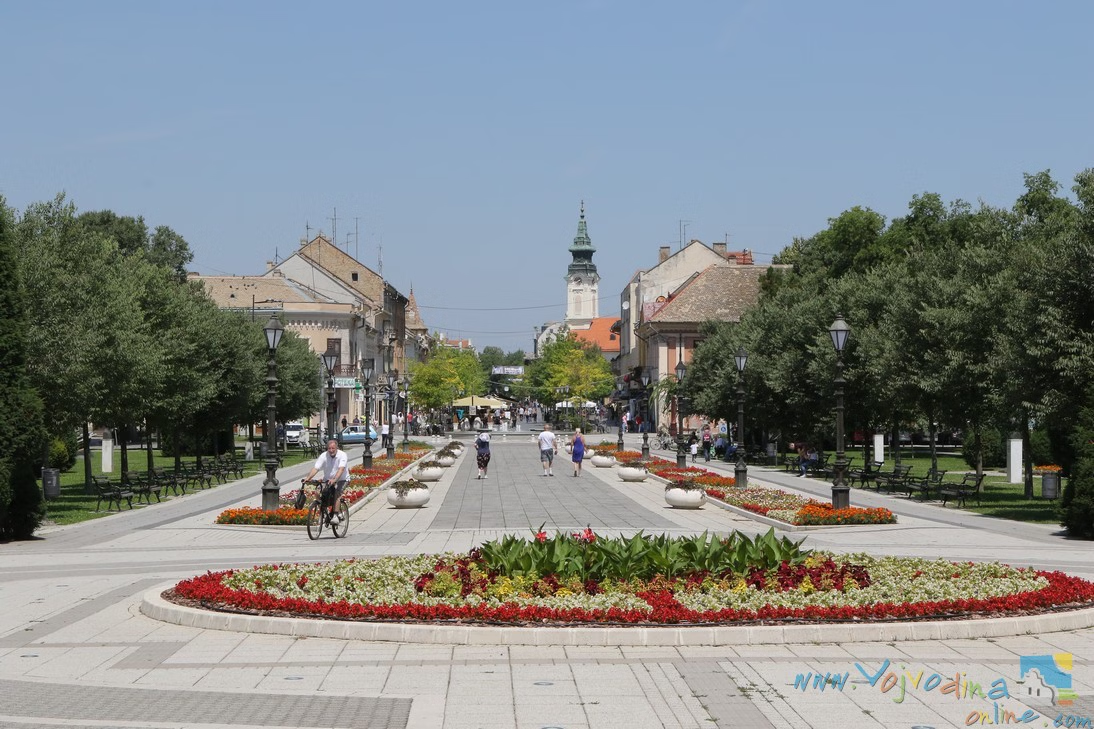
The city that has kept the charm of past times and in a unique way merged it with the spirit of people, years and the time passed through this plain, at times a military village, the greenest city in Serbia, all this is Sombor.
The city of carriages, tamburitza bands, painters, poets, with the honour of having more than forty songs dedicated to it, and the city where the current anthem of the Republic of Serbia “God of Justice” was created. It is also where the famous poem of the Somborian son-in-law Laza Kostić “Santa Maria della Salute” was written. Sombor carries the epithet of the green city because of the large number of parks and green areas. Here you can have a unique, timeless experience by hopping on a carriage – a prominent symbol of the city. Today there are nineteen of them remaining in Sombor.
This green oasis is also famous for its rich cultural heritage. Almost all the points of interest are within four streets in the city centre. The City Hall is the most prominent building of neoclassicism. In close proximity is the City Museum, the Serbian Reading Room, the Milan Konjović Gallery, with a collection of 500 selected works. Here are also the churches of the Holy Trinity and Plebania, St. John the Forerunner and the northernmost monastery in Serbia, the monastery of the Holy Archbishop Stevan.
In addition to the listed sites, the Županija (County Hall) with its beautiful park should not be missed. The famous oil on canvas “The Battle of Senta” by Ferenz Eisenhut is kept in its interior and has a special value. It is also the largest oil on canvas in Serbia of imposing dimensions (7 by 4 m).
In front of the house where Laza Kostić wrote a song about his Lenka Dunđerski, there is a memorial bench. Laza was not born in Sombor, he did not spend his youth in this city, but he left a great mark above all through his creativity and engagement in the Serbian Reading Room, whose president he was.
The Carmelite Church with interior decorated with sculptures and stained-glass windows should also be visited, and it also houses an organ from 1926.